
1859 Excelsior, Brooklyn (Excelsiors)
As historic baseball photos go, this well-known image is one of the best. It shows two of the game’s most important early clubs, Knickerbocker of New York, standing left, and Excelsior of Brooklyn, standing right, outdoors, in situ, basking in the sun of 1859.
Photo A
Historian Tom Shieber describes this image as “the earliest-known on-field baseball photograph,” made “at the Excelsior’s grounds, August 2, 1859. Excelsior BBC topped the Knickerbockers that day, 20-5.”
MLB Historian John Thorn agrees, writing that the image was “by Williamson at the Excelsior grounds, August 2, 1859. Long identified as being shot in 1858.”
As with most early images, there is confusion as to when and where this photo was taken. Existing prints have both 1858 and 1859 attached to it. Even today some websites differ on the exact date and place, citing September 3, 1859, and Elysian Fields, Hoboken, New Jersey, as the date and place. However according to the Brooklyn Evening Star, September 5, 1859, Excelsior played (and lost) to Star of Brooklyn with James Creighton on September 3, 1859, not Knickerbocker. In recent years these differing dates have been picked up, posted, and passed on.
If we look at the five known contests between the two clubs in the period of 1858-1860, we can eliminate the following three dates:
–July 8, 1858, at Brooklyn, Excelsior grounds, Carroll Park. This game can be eliminated as the box score does not include Harry Wright of the Knickerbockers, who was shown in photo A, standing sixth from left.
–August 20, 1858, at Hoboken, NJ, “Gotham grounds,” Elysian Fields. This game can likely be eliminated as Excelsior player Pearsall, identified in photo A and standing 8th from right, seemingly did not join the club until the 1859 season. Apparently, no box score was published for this game.
–August 25, 1860, at Brooklyn, Excelsior grounds, foot of Court Street. This game can be eliminated as the box score included Excelsior pitcher James Creighton, who was not included in photo A.
That leaves the following two matches from 1859 as contenders:
–June 30, 1859, at Hoboken, NJ, Elysian Fields. The New York Times on July 1, 1859, reported that “the game was an experimental one, to determine the relative merits of putting out men when fair struck balls were caught on the fly, as contrasted with the rule adopted by the baseball convention, of allowing men to be put out when fair struck balls were caught either on the bound or fly.” The umpire for this game was A. J. Bixby of the Eagle Club, New York. In photo A, the man standing between the two teams may be the umpire. He holds the game ball, wearing a long coat, top hat, and beard. Bixby also wore a beard in a drawing published in 1865, however a confirmation cannot be made that Bixby is in photo A.
–August 2, 1859, at South Brooklyn, Excelsior grounds, Penny Bridge. The Brooklyn Evening Star reported the following day that “the match was played within two hours and demonstrated, as did the former, that instead of retarding or embarrassing the game, the fly rule adds to its scientific precision and contributes much to the spirit and interest of the sport.” The umpire for this game was Peter O’Brien of the Atlantic club, Brooklyn. Contemporary photos of O’Brien do not match our top-hatted friend in the center of the image.
Albert Spalding in his 1911 book, America’s National Game, identified the gentleman with the top hat as “Dr. Jones.” Dr. Jones was Dr. Joseph Bainbridge Jones (1823-1905), Excelsior president during the late 1850s and early 1860s, and president of the NABBP in 1860. The consensus opinion amongst historians today is that it was indeed Dr. Jones in the middle of photo A and that the image was made August 2, 1859, in Brooklyn at the Excelsior Grounds. As Excelsior won the match 20 to 5, Jones holds the game ball as a trophy, or did he? Historian Tom Gilbert has written that Jones “is about to offer the game ball to the losing team, the Knickerbockers, as a display of deference and respect.” The fact the game had just concluded could be suggested by the players’ hair, which in many cases was matted down as they removed their caps.
Comparison of Dr. Jones in photo A with that published with his obituary in the Brooklyn Daily Times, October 10, 1905, page 12. When Dr. Jones died in Brooklyn it was stated that “he was an ardent devotee of athletics and out-of-door sports, and he was the organizer of the first prominent professional baseball club of this community.”
Identifying the Excelsior players.
Dated August 2, 1859. Detail view of Photo A.
In America’s National Game, Albert Spalding listed the Excelsiors in photo A standing right of Dr. Jones as Polhemus, Pearsall, Leggett, Holden, Russell, Dupont, H. Brainard, unidentified and unidentified. A box score from the August 2 game published in the Brooklyn Evening Star listed the Excelsiors lineup as Reynolds 2b, Pearsall 1b, Russell p, C Whiting rf, Holden ss, Polhemus cf, Markum lf, J C Whiting 3b, Leggett c. The scorer was S. S. Gregory. Clearly Spalding and the Star were not in agreement; according to the Star neither Dupont nor Brainard appeared in the August 2 game.
When comparing photo A to a known photo of the Excelsior team from 1860, the following identities can be made. The identity of Charles Whiting, brother to John, is determined by the process of elimination.
The Excelsior uniform.
The Excelsior players wore a variety of shield-front shirts in photo A. Per Charles A. Peverelly, The Book Of American Pastimes (1866), the traditional colors of the Excelsior uniform were blue pants and cap, with white shirt, belt and shoes.
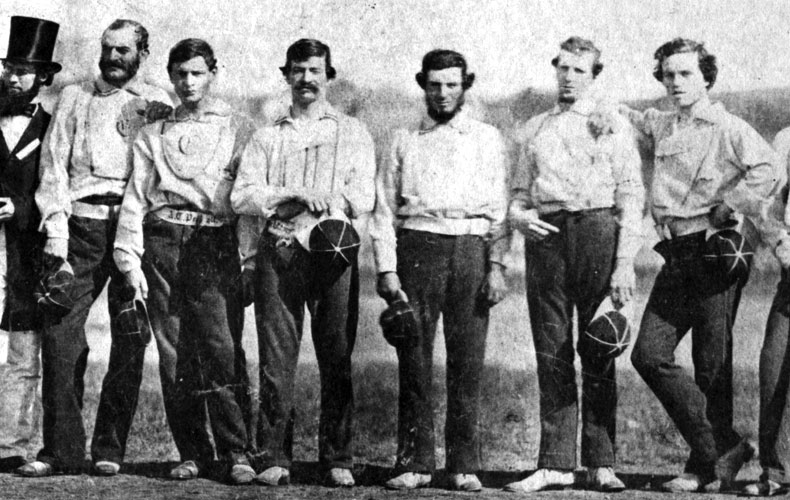
Dated August 2, 1859. Another detail view of Photo A. Detail view shows a variety of shield configurations. The players at the far left and the three players at the far right of this detail view wore a shield with a flat bottom. The far left shield had the letter “E” in the center. Based on the quality of the photo it is hard to determine if the other flat-bottomed shields also had a letter. The player second from left wore a shield that was actually shield-shaped and with a large letter “E”. The player third from left wore a shield with extra decorative trim down the middle. All of these shields were accented with a dark-colored trim. He and several other players had their shield unbutttoned at the neck indicating a warm summer day.
Dated August 2, 1859. Still another detail view of Photo A. Note that two players had lettering on their belts, while the remaining Excelsior players did not. The belt in the center of this detail view carried the player’s name, A. C. Pearsall, not the team name. Also note the style of cap held by the players. It featured white ribs on a dark rounded crown and a large white visor. This style of cap was often called a “jockey cap” and is somewhat similar to today’s baseball cap.
The location of photo A.
The August 2nd match was played at the Excelsior grounds in Brooklyn, located in the area known as Red Hook in South Brooklyn. I asked historian Tom Gilbert to tell me more about the Excelsior grounds. He replied that “the Red Hook grounds were at the foot of Court Street and there is a public baseball diamond on that same spot today. (The Excelsiors previously played at Carroll Park, about a mile to the north.) The Red Hook site is several blocks south of the former Penny Bridge, which was on what is now Hamilton Avenue. It is probable that the high ground behind the players was located east of the Gowanus inlet. Today, a slope is ascending there in the direction of the present park.”
—Information from Marshall D. Wright, The National Association Of Base Ball Players, 1857-1870 (2000), from William Ryczek, Peter Morris and others, Base Ball Founders (2013), from wikipedia.com, and from sabr.org. Info on Dr. Jones, club president, from Base Ball Founders and Thomas W. Gilbert, How Baseball Happened (2020).
Written documentation on this uniform:
The following year, on July 3, 1860, Excelsior played Victory of Troy NY, at Troy, Wier’s Course. The uniform was describes as follows: “The Excelsiors wore a pretty uniform — blue caps, white merino [wool] shirts, trimmed with blue, white belts, blue pants and white shoes.” From the Troy (NY) Daily Whig, July 4, 1860. Research from Ed Morton.
Team genealogy: Excelsior, Brooklyn, 1854-1870s
Excelsior was formed in Brooklyn, NY, in late 1854. The club was one of 16 charter members of the National Association of Base Ball Players (NABBP), baseball’s first organization, operating 1857-1870. Named after the New York State motto, Excelsior was noted for organizing one of the first baseball tours, traveling to upstate New York in 1860 and playing in Albany, Troy, Buffalo, Rochester and Newburgh. Excelsior retained amateur status with the advent of open professionalism in 1869 and ceased to play games competitively in the 1870s. The success and popularity of the club before the Civil War led to frequent use of the Excelsior name by other teams in all areas of the country. Info from William Ryczek, Peter Morris and others, Base Ball Founders (2013).
Rendering posted: May 25, 2014
Diggers on this uniform: Tom Gilbert,