
1859 Knickerbocker, New York (Knickerbockers)
This rendering is based on visual documentation for uniform style and written documentation for color. Minor details may be undocumented or difficult to determine. An educated guess is made to complete the rendering.
Rendering accuracy:Year: unconfirmed Team: documented
This rendering is included in the book, BASEBALL THREADS.
Visual documentation on this uniform:
Photo A
As historic baseball photos go, this well-known image is one of the best. It shows two of the game’s most important early clubs, Knickerbocker of New York, standing left, and Excelsior of Brooklyn, standing right, outdoors, in situ, basking in the sun of 1859.
Historian Tom Shieber describes this photo as “the earliest-known on-field baseball photograph,” made “at the Excelsior’s grounds, August 2, 1859. Excelsior BBC topped the Knickerbockers that day, 20-5.” This was a second game in which the two teams explored playing with “fly game.” The Brooklyn Evening Star reported on August 3rd that “the match was played within two hours and demonstrated, as did the former, that instead of retarding or embarrassing the game, the fly rule adds to its scientific precision and contributes much to the spirit and interest of the sport.” The image has been attributed to photographer Charles Williamson, Brooklyn.
A deep dive on the date and location of this image can be found here.
Identifying the Knickerbockers in photo A.
In America’s National Game, Albert Spalding in 1911 listed the Knickerbockers in photo A, from left, as unidentified, Davis, De Bost, unidentified, Stevens, Harry Wright, unidentified, Kissam, and unideintified. A box score from the August 2 game published in the Brooklyn Evening Star listed the Knickerbocker lineup as Davis lf, Wright c, McLaughlin p, Stephens [Stevens] 1b, Kissam rf, Morrow cf, De Bost ss, Adams 3b, and Welling 2b.
In his book Spalding, oddly, did not identify Daniel ‘Doc’ Adams, an important figure in Knickerbocker history. He also did not identify players Henry Morrow, Norman Welling or Napoleon McLaughlin, and their identities remain unconfirmed. A Civil War-era photo of McLaughlin is included in the facial study below for comparison. Morrow’s first name is not known in many contemporary resources. However, Charles Peverelly in his Book of American Pastimes (1866) listed Henry Morrow of the Knickerbocker Club as the umpire of the Excelsior-Empire match played on September 14, 1859. Researcher Paul Winter found that Morrow was later mayor of Iowa City, IA. A newspaper report from Iowa City in April 1896 said the “Col. Henry Morrow is among the old-time ball players who might have participated in the Harry Wright game at Rockford, Ill., Monday [April 13] if he had wished. Way back in the ‘60s he was a member of the old Knickerbocker club — the parent team of the United States.” Morrow was born in New York in 1826 and died in Iowa City on May 3, 1906.
The Knickerbocker uniform of 1859.
In photo A, the Knickerbocker players wore a shirt with a wide button placket and a shirt pocket, each accented with dark trim. The team’s initials were carried on the belt of each player. See detail views below for more on these uniform features. The traditional uniform color of the Knickerbocker team during this period was white shirt with blue pants.
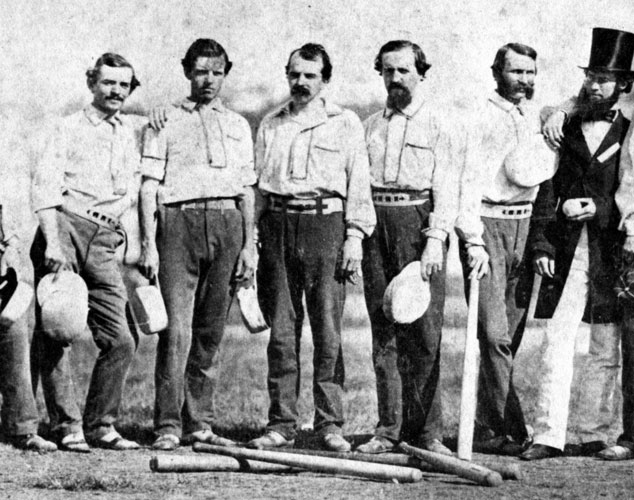
Dated August 2, 1859. Detail of photo A. Detail view show the button placket ending above the belt and trimmed with dark blue. The shirt pocket was also trimmed with blue. The caps shown in this photo did not have a rounded crown but instead a flat, pill box shape.
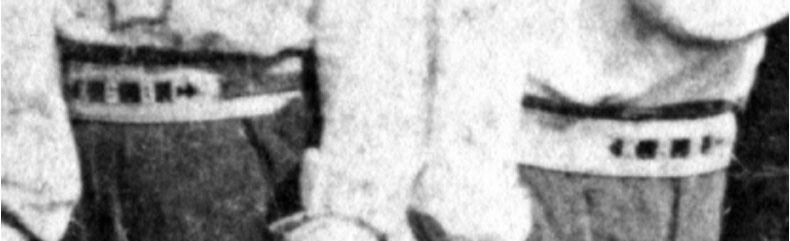
Dated August 2, 1859. Another detail view of photo A showing Knickerbocker belt displaying the team’s initials: “KBBC.”
Written documentation on this uniform:
1849-1866: “On April 24, 1849, a uniform was adopted for the club: blue woolen pantaloons, white flannel shirt, chip (straw) hats; and it may here be mentioned that the blue and white has ever since remained the costume of the club. The straw hats were abolished some years later. […] On the 13th of August, 1855, the uniform of the club was again regulated. Blue woolen pants, white flannel shirt, with narrow blue braid, mohair cap, and belt of patent leather. With the exception of a change of cap, the uniform has ever since remained.” From Charles A. Peverelly, The Book Of American Pastimes (1866).
Team genealogy: Knickerbocker, New York, 1845-late 1860s.
Knickerbocker loosely formed in New York in 1842 and officially organized in 1845. The term Knickerbocker derived from a surname that symbolized the city’s Dutch origins. The club published a well-known set of game rules in 1845 which helped to codify the New York-style game. Knickerbocker was one of 16 charter members of the National Association of Base Ball Players (NABBP) in 1857. The NABBP was baseball’s first organization, operating 1857-1870. The Knickerbocker club ceased to play games competitively in the late 1860s. Afterward, the Knickerbocker name has been used by many New York sports teams, including the NBA franchise, which took the name in 1946. Information from John Thorn, William Ryczek, Peter Morris and others, Base Ball Founders (2103), and from wikipedia.com.
Rendering posted: June 14, 2014
Diggers on this uniform: Paul Winter,
Other uniforms for this team:
1849 Knickerbocker, New York
1864 Knickerbocker, New York
See full database