
1869 Union, Lansingburgh NY (Unions, Troy Haymakers)
This rendering is based on visual documentation for uniform style and written documentation for color. Minor details may be undocumented or difficult to determine. An educated guess is made to complete the rendering.
Rendering accuracy:Year: documented Team: documented
This rendering is included in the book, BASEBALL THREADS.
Visual documentation on this uniform:
Photo A
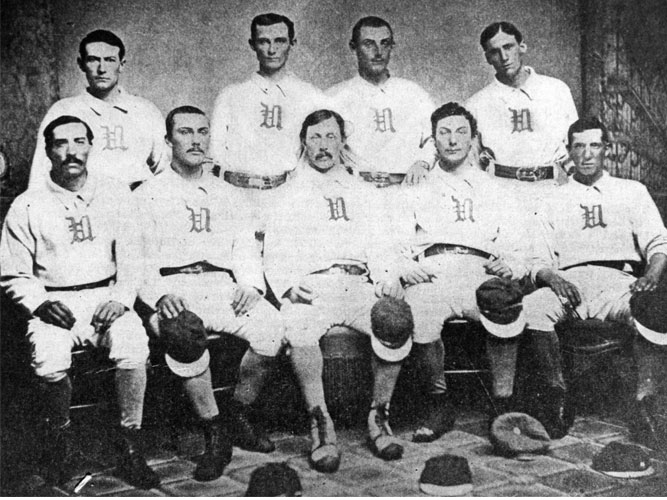
Dated 1869. Photo date based on appearance of players Flynn, M King and McAtee in combination with players Bellan and Fisher. These men only played at the same time for Union in 1869. Players wore a white uniform with light-colored stockings. The cap was dark with a white visor.
Top row, from left: unidentified, C Flynn (66-69, 71), S King (66-72) and S Bellan (69-72). Front row: B Craver (66-71), unidentified, C Fisher (69-70), M King (67-69, 72) and B McAtee (66-69, 72). Years with team from Peter Morris, Base Ball Pioneers, 1850-1870 (2012) and Paul Batesel, Players And Teams Of The National Association, 1871-1875 (2012). Image from Mark Fimoff, SABR 19th-century Pictorial Committee. Based on box scores from this year, the unidentified players were C Bearman (69) and M Powers (69), however a positive identification cannot be made for either.
Written documentation on this uniform:
May 1869: “Messrs. Peck and Snyder have been getting up a very neat and tasteful uniform for the Haymakers, consisting of blue gray caps trimmed with white, white shirts trimmed with blue, and blue gray pants trimmed with white.” From the New York Dispatch, May 23, 1869. Research from Ed Morton. This uniform likely included long pants, the team switched to short pants in August 1869.
May 1869: “The Unions of Lansingburg[h] will open their new grounds on Monday next [May 31] in their new uniforms, with a new regulation ball and new bats. […] This news will have the effect, no doubt, of sending a large crowd to the mowing field, where the ‘Haymakers’ intend to do their heavy work.” From the New York Daily Herald, May 28, 1869.
August 1869: “The friends of the Haymaker base ball club have ordered a very complete and beautiful uniform for the club, to be presented to the nine prior to their departure upon their Southern and Western tour. It will consist of red merino camps with white leather visors, made in Pettis & Ranken’s best style; white Shaker flannel shirts, white corduroy pants, buttoned at the knee, blue stockings and red belts — the manufacturer of the shirts and pants being entrusted to Mr. Carnell. The uniform will typify the colors of the Union as well as those of the Union-Haymakers, and it will be in all respects the most beautiful and costly of any base ball outfit in the country. The Haymakers will appear in it for the first time in their match with the champion Eckfords on Saturday next [August 21, 1869]. Levi Smith was the prime mover in the enterprise of purchasing the uniform.” From the Troy (NY) Daily Times, August 18, 1869, page 3. Research from Bob Tholkes. The 1865 Troy city directory listed Julius R. Pettis & Co., as a manufacturer, wholesale and retail dealers in hats, caps, furs and straw goods. James Carnell was listed as a merchant tailor in Troy, and Levi Smith was likely the attorney by that name living in Troy on Second Street.
August 1869: “The match between the Haymakers [aka Union, Lansingburgh] and the Keystone club of Philadelphia takes place this afternoon [August 19, 1869] on the Haymaker grounds. […] The friends of the Haymaker club have ordered a very complete and beautiful uniform for the club, to be presented to the nine prior to the departure upon their Southern and Western tour. It will consist of red merino caps with white leather vizors, white Shaker flannel suits, with corduroy pants, buttoned at the knee, blue stockings and red belts.” From the Albany (NY) Morning Express, August 19, 1869. Research from Ed Morton. “Merino” is a soft woolen or wool-and-cotton material resembling cashmere.
August 1869: “The Haymakers play the champion Eckfords, of Brooklyn, on the Union grounds tomorrow afternoon [August 21, 1869], and will start on the Western and Southern trip in the evening. Instead of wearing their new uniform tomorrow, as announced, we think it would be well for the Union boys to wait until they get to Cleveland, and meanwhile play a few practice games on the [train] cars, so as to get used to them. No one ever yet felt comfortable in a new suit of clothes.” From the Troy (NY) Daily Press, August 20, 1869. Research from Ed Morton.
August 23, 1869, Union, Lansingburgh NY, (aka Haymaker) v. Forest City, Cleveland, at Cleveland: “Their uniform, with the exception of their caps, which are of a bright red color, is similar to that of the Forest City [of Cleveland.] The pants and shirts are white, with monogrammed ‘H’ on breast, and the stockings blue.” From the Cleveland Herald, August 24, 1869, researched by Peter Morris, Base Ball Pioneers, 1850-1870 (2012). Note: possibly the Cleveland reporter saw the ‘U’ on the shirt as an ‘H’, or the reporter assumed the letter was an ‘H’ because of the Haymaker nickname.
September 1, 1869, Union, Lansingburgh NY, (aka Haymaker) v. National, Washington DC, at Washington: “The Haymakers are a splendid looking set of men, and wore a very becoming uniform, as follows: white flannel shirt, white corduroy knee-breeches, long blue stockings, red belts and red scull-caps [sp?]. On the breast of the shirt was the letter “U,” in old English text.” From the National Republican (Washington DC), September 2, 1869. Research from Ed Morton.
September 1869: “White flannel shirt emblazoned with ‘U’ in old English text, white corduroy knee-breeches, blue stockings, red belts and scull-caps.” From the Chadwick Scrapbooks, researched by Peter Morris, Base Ball Pioneers, 1850-1870 (2012). This entry was most likely referenced from the National Republican, September 2, 1869, see above.
September 29, 1869, Union, Lansingburgh NY, (aka Haymaker) v. Atlantic, Brooklyn, at Capitoline Grounds, Brooklyn: “The ‘Haymakers’ made their appearance about 2 o’clock, and, having left their hotel with their uniforms on, were all in readiness to commence operations. […] The ‘Haymakers’ appeared in their new Knickerbocker uniform for the first time in this vicinity.” From the New York Clipper, October 9, 1869. This report called the team “Troy” and “Haymakers,” and did not call the team “Union” or “Lansingburgh.”
Circa 1869, recalled in March 1905: “The Haymakers of Lansingburg[h], now Troy, N. Y., on their first rip to New York and Brooklyn to play the Atlantics and the Mutuals, put up at the Grand Central Hotel in Manhattan. On their first day in Gotham they started out early in the morning, dressed in their new baseball uniforms, causing a great deal of amusement among the people on Broadway.” From the Brooklyn Daily Eagle, March 26, 1905, as part of an article entitled, “Jack Chapman Talks the National Game.” The blurb was published again by the Eagle on June 11, 1916, at the death of Chapman.
Team genealogy: Union, Lansingburgh NY, 1865?-1872
Union was formed in Lansingburgh, NY, in 1865 or 1866. Lansingburgh is located next to Troy, NY, and the Union club was often referred to as Troy or the Troy Haymakers. The Haymaker nickname originated in 1866 and may have derived from “hay raker”, a comment on the team’s rural roots, or reaction from one game when the team chose to play in bare feet for better traction. Union was commonly known as Troy when they played in the National Association (NA) in 1871 and 1872. The NA was baseball’s first league, operating 1871-1875. The team folded after the 1872 season. Information from Peter Morris, Base Ball Pioneers, 1850-1870 (2012).
Rendering posted: May 25, 2014
Diggers on this uniform: Bob Tholkes, Ed Morton,